
At Pro House Demolitions Brisbane, we regularly see these issues across Brisbane and surrounding suburbs. Most budget overruns are not caused by poor site work, but by decisions made too early, before approvals, utilities, and site conditions are fully confirmed by a professional team.
This article explains why rushing the planning stage leads to budget blowouts, how poor sequencing multiplies costs across the rebuild, and what must be locked in before work begins so homeowners can protect their budget and accurately understand overall demolition pricing.
Why Rushed Demolition Causes Budget Blowouts
Budget blowouts occur when work starts before approvals, services, and sequencing are properly confirmed. While the structure may come down quickly, costs escalate through fines, utility delays, rework, and unexpected interruptions to the rebuild.
Below is a breakdown of how rushed decisions create financial risk:
Demolition Starts Before Permits Are Fully Approved
Beginning work without all required council approvals exposes the project to stop-work orders and fines. When activity is halted, machinery and labour often remain on hire while approvals are resubmitted or amended. These delays increase holding costs and can trigger penalty rates from contractors waiting on site.
In Brisbane, missing approvals are treated as compliance breaches, not minor paperwork issues. Even a short shutdown can delay demolition for weeks and disrupt the entire rebuild schedule, including landscaping and landscape restoration timelines.
Permit Shortcuts That Lead to Fines and Stop-Work Orders
Permit shortcuts lead to fines and stop-work orders when activity begins without approved permissions for vegetation removal, erosion control, traffic management, or neighbour protection.
Common shortcuts include:
- Starting demolition before tree or vegetation approvals are cleared
- Skipping erosion, sediment, or dust control plans
- Failing to lodge traffic control or footpath protection plans
- Ignoring neighbour and boundary protection requirements
Once a stop-work order is issued:
- Machinery and crews sit idle while still on hire
- Permits must be resubmitted with revised documentation
- Additional inspections and compliance fees apply
- Builder schedules are disrupted and may need to vary
Permits cannot be fixed while demolition continues. Work must stop completely until approvals are reinstated. What appears to save time often becomes one of the most expensive mistakes.
Hazardous Materials Discovered Too Late
Discovering asbestos or other hazardous materials after work has started is one of the fastest ways for costs to spiral.
Late discovery leads to:
- Emergency mobilisation of licensed contractors at premium rates
- Mandatory work stoppages for inspections and clearance
- Re-sequencing of downstream trades
- Additional compliance documentation and reporting
In Queensland, failing to identify asbestos before demolition can breach workplace safety laws and council conditions. Early hazardous material surveys cost far less than emergency removal during active works and should be completed before any renovation or knockdown decision is finalised.
Utility Disconnection Mistakes That Delay Demolition
Utility disconnection mistakes cause delays when services are cut in the wrong order, at the wrong time, or without confirmation. Power, gas, water, and sewer must be disconnected in a strict sequence.
The correct order is:
Power, then gas, then water, then sewer.
Disconnecting too late creates safety shutdowns and stop-work directions. Disconnecting too early adds temporary power costs, reconnection fees, and holding expenses. Solar systems, overhead lines, and electrical metering must also be included in planning.
Poor coordination with utility providers is a common cause of unplanned delays and budget overruns.
How Does Poor Sequencing Trigger Cost Overruns in Demolition Projects?
Poor sequencing triggers cost overruns because work begins before critical prerequisites are locked in. This causes delays, rework, penalties, and repeated mobilisation costs. When steps happen out of order, small mistakes compound into major financial blowouts that homeowners need to consider early.
Common sequencing traps include:
- Demolishing before all permits are approved
- Incorrect timing of power, gas, and water cut-offs
- Starting without final rebuild levels or footing plans
Each mistake adds delays and rework that multiply across the project.
Unplanned Site Conditions That Force Engineering Variations
Hidden site problems often turn simple projects into engineering issues.
Common surprises include:
- Rock or buried footings
- Old septic tanks or fill
- Weak or reactive soil
When engineers cannot rely on assumed site conditions, footings and slabs must be redesigned. This can trigger deeper piers, thicker slabs, additional reinforcement, and new approvals. These variations are costly and usually appear during the rebuild phase, not demolition.
How Access and Logistics Errors Drive Up Demolition Labour Costs
Poor access is one of the most underestimated cost drivers in residential projects. It rarely changes the scope, but it dramatically increases labour hours, equipment downtime, and coordination costs, especially in constrained metro areas such as Sydney.
Common issues include:
1. Restricted Machinery Access Increases Manual Labour
When excavators, loaders, or trucks cannot reach the structure directly, demolition crews are forced to rely on manual handling. Materials that should be removed mechanically end up being cut, carried, or stockpiled by hand.
This results in:
- More workers are required on-site
- Longer shifts to complete the same volume of work
- Higher fatigue and slower productivity
Manual handling is always more expensive per cubic metre than machine-based demolition.
2. Narrow Driveways and Tight Streets Slow Every Stage
Homes on narrow driveways or tight suburban streets often face:
- Limited turning space for trucks
- One-way access that forces staged loading
- Delays while vehicles are repositioned or marshalled
Each movement takes time, and time equals labour cost. What should be a one-day demolition can easily stretch into multiple days purely due to access constraints.
3. Sloping Blocks Add Setup and Safety Labour
Demolition on sloped or uneven sites requires additional preparation:
- Temporary ramps or benching
- Machine stabilisation
- Slower operating speeds for safety
Crews must work more cautiously, and machines operate below peak efficiency. These safety-driven slowdowns increase paid labour hours without increasing output.
4. Poor Bin and Truck Placement Creates Idle Time
If skip bins or waste trucks cannot be placed close to the demolition zone:
- Workers walk materials over longer distances
- Machines pause while bins are swapped
- Crews wait for street access windows or traffic control
Idle labour is still paid labour. Even short delays repeated throughout the day compound into significant cost overruns.
5. Neighbour and Boundary Constraints Limit Working Space
Close neighbours, shared driveways, fences, and boundary walls reduce working clearances. This often forces:
- Smaller machines instead of efficient full-size excavators
- Sequential demolition instead of bulk removal
- Extra spotters and safety staff
Each restriction reduces speed and increases labour intensity.
6. Late Discovery of Access Issues Forces Rework
When access is not assessed early, demolition contractors may arrive with the wrong equipment or bin sizes. This leads to:
- Stand-down time while plans are adjusted
- Additional site visits
- Extra mobilisation and labour costs
These costs rarely appear in the original quote but show up as variations once work begins.
Insurance and Liability Gaps That Create Financial Exposure
Insurance and licensing gaps are often underestimated risks. When unlicensed or under-insured crews are used, even minor damage or injury can become a serious financial liability for the homeowner.
The Three Covers Every Homeowner Must Verify
Before demolition or site works begin, homeowners should confirm—in writing—that the contractor holds all of the following:
QBCC licence
This confirms the contractor is legally permitted to perform demolition or building-related work in Queensland and is subject to regulatory oversight.
Public liability insurance
This covers accidental damage to property and injury to third parties, including neighbours. Without it, repair costs and legal claims can fall directly on the homeowner.
Workers’ compensation cover
This protects against claims arising from worker injuries. If a worker is injured and the contractor has no workers’ compensation policy, the homeowner may be pursued for medical costs and compensation.
Copies of current certificates should be requested and checked before any contract is signed—not after work starts.
How Early Demolition Mistakes Inflate Rebuild Prices
Early mistakes inflate rebuild prices by forcing redesigns, remediation work, and risk allowances. When ground conditions, services, or documentation are compromised, builders increase quotes to cover uncertainty.
Top three hidden extras:
1. Footing and Slab Redesigns After Demolition
One of the most expensive consequences of early demolition mistakes is footing or slab redesign.
Common causes include:
- Incorrect demolition levels that do not match approved building plans
- Uncontrolled excavation that disturbs the natural ground
- Poor spoil removal that alters soil bearing capacity
- Missing or damaged survey reference points
When engineers cannot rely on the site conditions assumed in the original design, footings must be recalculated. This can trigger deeper piers, thicker slabs, additional reinforcement, or redesign of edge beams. Each change adds engineering fees, new approvals, and higher material and labour costs.
For homeowners, this often appears as a “variation” during the rebuild, even though the problem started during demolition.
2. Site Clean-Up, Drainage, and Ground Remediation Costs
Demolition that focuses only on knocking a structure down often leaves the site unbuildable.
Hidden rebuild cost drivers include:
- Inadequate removal of concrete and buried debris
- Poor surface grading that traps water
- Compacted fill in areas meant to be natural ground
- Blocked or damaged stormwater lines
Before construction can start, builders must restore a compliant building platform. This may involve additional excavation, import of clean fill, temporary drainage systems, or rework of stormwater infrastructure. These costs are rarely included in initial rebuild estimates and can add thousands of dollars before construction even begins.
3. Rebuilding Damaged Driveways, Fences, and Neighbouring Assets
Early demolition mistakes often extend beyond the site boundary.
Examples include:
- Cracked driveways from heavy machinery
- Collapsed or damaged boundary fences
- Kerb, footpath, or crossover damage
- Soil movement affecting neighbouring structures
Builders cannot proceed while access or boundary issues remain unresolved. Repairs must be completed first, and liability disputes can delay works further. Rebuild contractors factor these risks into their pricing, increasing margins or requiring contingency allowances to protect themselves from future claims.
Early demolition mistakes do not just affect the demolition budget. They directly increase rebuild costs through redesigns, remediation, and risk-loaded builder pricing. Strategic demolition planning reduces uncertainty, protects engineering assumptions, and keeps rebuild quotes accurate from day one.
Why Initial Quotes Rarely Reflect Final Spend
Initial demolition quotes are estimates based on limited site information. Hidden conditions such as asbestos, rock, access restrictions, service complications, and waste disposal requirements are often excluded.
Key points to remember:
- Provisional sums are allowances, not fixed prices
- A realistic contingency is 20 to 25 percent
- Detailed planning converts assumptions into accurate pricing
Rushed vs Strategic Demolition Planning: Cost and Time Compared
Rushed demolition planning usually costs 15–30 percent more and takes longer overall, while strategic demolition planning finishes faster and stays within budget because permits, utilities, and rebuild details are locked in before work starts.
Rushed planning: starts fast, hits delays, and costs 15–30 % more.
Strategic planning: waits until permits, utilities, and rebuild details are final — then runs smoothly.
The slower start finishes faster and cheaper.
When to Start Demolition and What Must Be Locked In First
You should start demolition only after all permits are approved, the rebuild design is final, utilities are booked for disconnection, and site logistics are confirmed. These are the items homeowners need to consider before committing to a start date.
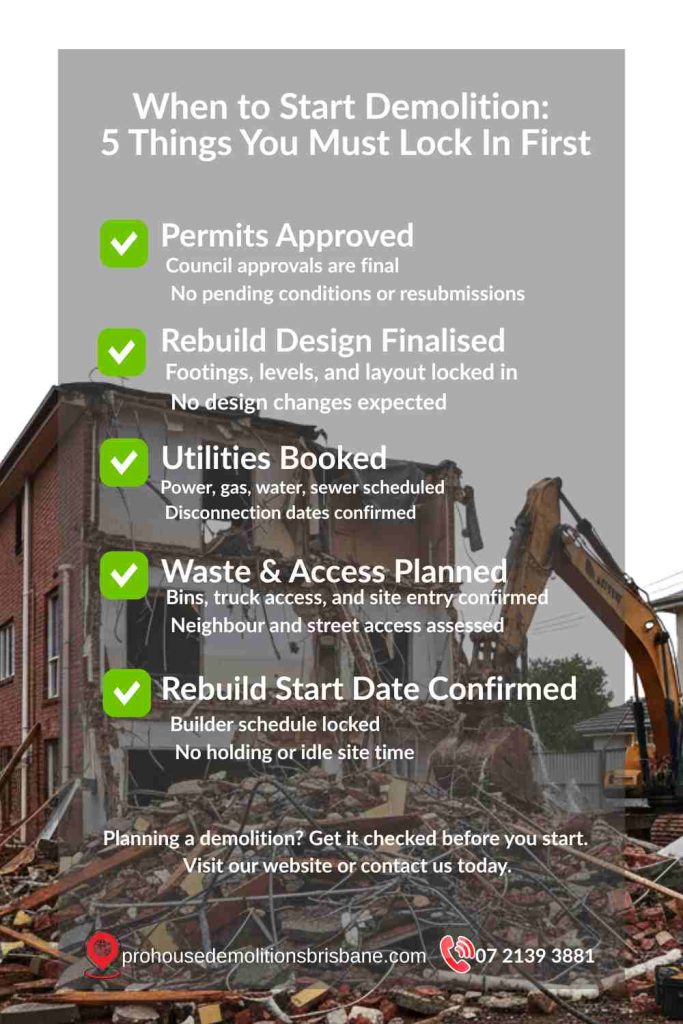
Demolition should begin only when permits, design, utilities, access, waste planning, and rebuild timing are fully confirmed. Starting too early shifts the risk onto the homeowner and inflates rebuild costs. Strategic timing turns demolition into a controlled step, not a costly gamble.
Final Takeaway: Budget Blowouts Start Before Demolition Begins
Most demolition budget blowouts start in the planning stage, not on-site. Rushed decisions, missing approvals, and poor sequencing create costs that appear later as fines, delays, and rebuild price increases.
Demolition work itself is usually straightforward. Planning mistakes are what make it expensive.
Ready to plan properly? Contact Pro House Demolitions Brisbane for demolition services, permit assistance, utility coordination, and full site risk checks.
FAQs
1. How do I know if my demolition planning is being rushed?
Your demolition planning is being rushed if work is scheduled before permits, utilities, site risks, and rebuild details are confirmed. Rushing removes certainty. Without clear sequencing, small unknowns turn into delays, fines, and budget overruns later.
2. What permits do I need before demolishing a house in Brisbane?
You need a Brisbane City Council demolition approval before work starts. You may also need approvals for asbestos removal, tree removal, and environmental controls. Missing any permit can stop work, trigger fines, and delay your rebuild timeline.
3. Can demolition mistakes really increase my rebuild costs later?
Yes, demolition mistakes can directly increase rebuild costs. Poor sequencing and site disturbance can force slab redesigns, extra piers, drainage changes, and remediation work. Builders price this uncertainty higher, which increases construction costs after demolition ends.
4. How much contingency should I allow for demolition costs?
A realistic demolition contingency is usually 20 to 25 percent. This covers hidden risks such as asbestos, rock, utility delays, and site conditions. Without contingency, even small issues can cause serious budget stress for homeowners.
5. When should I speak to a demolition contractor before starting?
You should speak to a demolition contractor before lodging final permits or booking utilities. Early advice helps confirm sequencing, risks, and access needs. This reduces surprises, protects your budget, and keeps the project moving smoothly.